Plausible-Value-Sensitive Academic Resilience Among Socioeconomically Disadvantaged Indonesian Students: Evidence from PISA 2022
DOI:
https://doi.org/10.56705/yp911595Keywords:
Academic Resilience, PISA 2022, Plausible Values, Socioeconomic Disadvantage, XGVoost, SHAP, IndonesiaAbstract
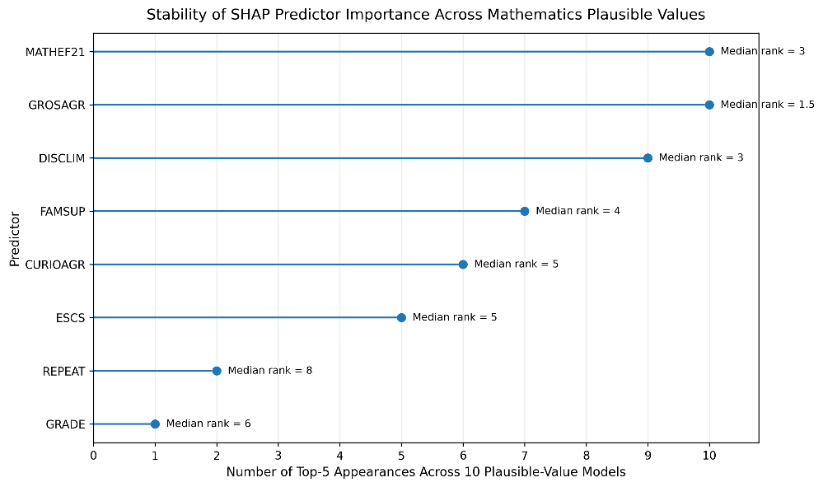
Introduction: Academic resilience refers to the ability of socioeconomically disadvantaged students to achieve strong academic outcomes despite structural constraints. However, resilience classifications derived from large-scale assessments may vary because student achievement is represented by multiple plausible values. Methods: This study analyzed PISA 2022 data from 13,439 Indonesian students across 410 schools. Socioeconomic disadvantage was defined using the weighted lowest quartile of the ESCS distribution, while academic resilience was identified separately for each of the ten mathematics plausible values using the weighted highest-quartile achievement threshold. Classification stability was examined across plausible values. Logistic Regression, Random Forest, and XGBoost were evaluated using five-fold school-grouped cross-validation, followed by predictor-domain ablation, SHAP-based importance analysis, and sensitivity testing. Results: An average of 15.20% of disadvantaged students were classified as academically resilient. However, 30.61% showed unstable classifications across plausible values, indicating substantial membership uncertainty. XGBoost achieved the best predictive performance with a weighted AUROC of 0.718 and AUPRC of 0.324. Psychological factors produced the largest incremental predictive gain beyond demographic and socioeconomic characteristics. Growth mindset, disciplinary climate, confidence in 21st-century mathematics skills, family support, and curiosity showed the most consistent predictive importance across plausible-value models. Conclusion: Academic resilience in Indonesia is measurable but not fully invariant across plausible values. Incorporating plausible-value sensitivity provides a more robust framework for identifying resilience and evaluating its associated protective factors.
References
[1] G. D. Borman and L. T. Overman, “Academic resilience in mathematics among poor and minority students,” The Elementary School Journal, vol. 104, no. 3, pp. 177–195, 2004, doi: https://doi.org/10.1086/499748.
[2] A. J. Martin and H. W. Marsh, “Academic resilience and its psychological and educational correlates: A construct validity approach,” Psychology in the Schools, vol. 43, no. 3, pp. 267–281, 2006, doi: https://doi.org/10.1002/pits.20149.
[3] T. Agasisti, F. Avvisati, F. Borgonovi, and S. Longobardi, “Academic resilience: What schools and countries do to help disadvantaged students succeed in PISA,” OECD Education Working Papers, no. 167, OECD Publishing, Paris, France, 2018, doi: https://doi.org/10.1787/e22490ac-en.
[4] OECD, PISA 2022 Results (Volume I): The State of Learning and Equity in Education. Paris, France: OECD Publishing, 2023, doi: https://doi.org/10.1787/53f23881-en.
[5] W. Ye, N. Teig, and S. Blömeke, “Systematic review of protective factors related to academic resilience in children and adolescents: Unpacking the interplay of operationalization, data, and research method,” Frontiers in Psychology, vol. 15, Art. no. 1405786, 2024, doi: https://doi.org/10.3389/fpsyg.2024.1405786.
[6] Kismiantini, E. P. Setiawan, A. C. Pierewan, and O. A. Montesinos-López, “Growth mindset, school context, and mathematics achievement in Indonesia: A multilevel model,” Journal on Mathematics Education, vol. 12, no. 2, pp. 279–294, 2021, doi: https://doi.org/10.22342/jme.12.2.13690.279-294.
[7] R. Aditia and K. Széll, “Belonging matters: How context and inequalities shape student achievement in Indonesia,” International Journal of Educational Research Open, vol. 9, Art. no. 100512, 2025, doi: https://doi.org/10.1016/j.ijedro.2025.100512.
[8] A. I. Latifah and K. Kismiantini, “How school culture and climate mediated student’s mathematics achievement: A path analysis of PISA 2022 Indonesia data,” Jurnal Pendidikan Progresif, vol. 15, no. 3, pp. 1670–1687, 2025, doi: https://doi.org/10.23960/jpp.v15i3.pp1670-1687.
[9] W. Ye, R. Strietholt, and S. Blömeke, “Academic resilience: Underlying norms and validity of definitions,” Educational Assessment, Evaluation and Accountability, vol. 33, pp. 169–202, 2021, doi: https://doi.org/10.1007/s11092-020-09351-7.
[10] P. Rachmadi, “A Pilot Study on Machine Learning Models for Predicting Student Pass/Fail Outcomes Using LMS Activity Logs and Interactive Dashboard Analytics,” Indonesian Journal of Data and Science, vol. 7, no. 2, pp. 183–189, 2026, doi: https://doi.org/10.56705/ijodas.v7i2.415.
[11] S. Sivakumar and S. Venkataraman, “Evaluating Machine Learning Approaches: A Comparative Study of Random Forest and Neural Networks in Grade Classification,” Indonesian Journal of Data and Science, vol. 6, no. 1, pp. 73–80, 2025, doi: https://doi.org/10.56705/ijodas.v6i1.240.
[12] Sumiyatun, Y. Cahyadi, and E. Faizal, “Implementation of Support Vector Machine Algorithm for Classification of Study Period and Graduation Predicate of Students,” Indonesian Journal of Data and Science, vol. 6, no. 1, pp. 55–63, 2025, doi: https://doi.org/10.56705/ijodas.v6i1.214.
[13] A. Halid, D. A. Purnamasari, A. C. Saputra, and N. M. Setiohardjo, “Explainable Machine Learning for Predicting the Mental Health Impact of AI and Digital Platform Usage among Students,” International Journal of Artificial Intelligence in Medical Issues, vol. 4, no. 1, pp. 1–18, 2026, doi: https://doi.org/10.56705/pxn6qg39.
[14] R. Setiawan, E. Najwaini, R. A. Azdy, and R. Rasyid, “Depression Risk Prediction Among Teenagers Using Explainable Machine Learning and Imbalanced Behavioral Data,” International Journal of Artificial Intelligence in Medical Issues, vol. 4, no. 1, pp. 54–71, 2026, doi: https://doi.org/10.56705/0w9q4238.
[15] P. A. Jewsbury, Y. Jia, and E. J. Gonzalez, “Considerations for the use of plausible values in large-scale assessments,” Large-scale Assessments in Education, vol. 12, Art. no. 24, 2024, doi: https://doi.org/10.1186/s40536-024-00213-y.
[16] K.-C. Cheung, P.-S. Sit, J.-Q. Zheng, C.-C. Lam, S.-K. Mak, and M.-K. Ieong, “A machine-learning model of academic resilience in the times of the COVID-19 pandemic: Evidence drawn from 79 countries/economies in the PISA 2022 mathematics study,” British Journal of Educational Psychology, vol. 94, no. 4, pp. 1224–1244, 2024, doi: https://doi.org/10.1111/bjep.12715.
[17] OECD, PISA 2022 Technical Report. Paris, France: OECD Publishing, 2024, doi: https://doi.org/10.1787/01820d6d-en.
[18] L. Breiman, “Random forests,” Machine Learning, vol. 45, no. 1, pp. 5–32, 2001, doi: https://doi.org/10.1023/A:1010933404324.
[19] T. Chen and C. Guestrin, “XGBoost: A scalable tree boosting system,” in Proc. 22nd ACM SIGKDD Int. Conf. Knowledge Discovery and Data Mining, San Francisco, CA, USA, 2016, pp. 785–794, doi: https://doi.org/10.1145/2939672.2939785.
[20] F. Pedregosa et al., “Scikit-learn: Machine learning in Python,” Journal of Machine Learning Research, vol. 12, no. 85, pp. 2825–2830, 2011.
[21] T. Saito and M. Rehmsmeier, “The precision-recall plot is more informative than the ROC plot when evaluating binary classifiers on imbalanced datasets,” PLoS ONE, vol. 10, no. 3, Art. no. e0118432, 2015, doi: https://doi.org/10.1371/journal.pone.0118432.
[22] S. M. Lundberg and S.-I. Lee, “A unified approach to interpreting model predictions,” in Advances in Neural Information Processing Systems, vol. 30, pp. 4765–4774, 2017.
[23] OECD, PISA 2022 Results (Volume V): Learning Strategies and Attitudes for Life. Paris, France: OECD Publishing, 2024, doi: https://doi.org/10.1787/c2e44201-en.
[24] R. B. King, J. Li, and Y. Wang, “Both individual and peer growth mindsets matter for academic resilience,” npj Science of Learning, vol. 11, Art. no. 17, 2026, doi: https://doi.org/10.1038/s41539-026-00403-z.
[25] H. Azis, Purnawansyah, F. Fattah, and I. P. Putri, “Performa Klasifikasi K-NN dan Cross-validation pada Data Pasien Pengidap Penyakit Jantung,” ILKOM Jurnal Ilmiah, vol. 12, no. 2, pp. 81–86, 2020, doi: https://doi.org/10.33096/ilkom.v12i2.507.81-86.
[26] H. Azis, F. T. Admojo, and E. Susanti, “Analisis Perbandingan Performa Metode Klasifikasi pada Dataset Multiclass Citra Busur Panah,” Techno.Com, vol. 19, no. 3, pp. 286–294, 2020, doi: https://doi.org/10.33633/tc.v19i3.3646.
[27] H. Azis, Purnawansyah, Nirwana, and F. A. Dwiyanto, “The Support Vector Regression Method Performance Analysis in Predicting National Staple Commodity Prices,” ILKOM Jurnal Ilmiah, vol. 15, no. 2, pp. 390–397, 2023, doi: https://doi.org/10.33096/ilkom.v15i2.1686.390-397.
[28] H. Azis, Purnawansyah, and N. Alfiyyah, “Multiclass Classification on Nominal Value of Rupiah Banknotes Based on Image Processing,” ILKOM Jurnal Ilmiah, vol. 16, no. 1, pp. 87–99, 2024, doi: https://doi.org/10.33096/ilkom.v16i1.1784.87-99.
[29] H. Azis and N. Rismayanti, “Prediksi Anemia dari Pixel Gambar dan Level Hemoglobin Menggunakan Random Forest Classifier,” Jurnal Ilmiah NERO, vol. 9, no. 1, pp. 21–34, 2024, doi: https://doi.org/10.21107/nero.v9i1.27916.
[30] OECD, PISA 2022 Results (Volume II): Learning During – and From – Disruption. Paris, France: OECD Publishing, 2023, doi: https://doi.org/10.1787/a97db61c-en.
Downloads
Published
Issue
Section
License
Copyright (c) 2026 Nusantara Journal of Multidisciplinary Informatics
Creative Commons Attribution-NonCommercial 4.0 International (CC BY-NC 4.0)Copyright remains with the author(s), and articles are published under Creative Commons Attribution-NonCommercial 4.0 International (CC BY-NC 4.0).