Predicting the Rule, Not the Load: A Construct-Validity and Validation-Leakage Audit of Steel Industry Load-Type Classification
DOI:
https://doi.org/10.56705/gk35p778Keywords:
Construct Validity, Industrial Energy Consumption, Load Classification, Machine Learning, Temporal Validation, Validation LeakageAbstract
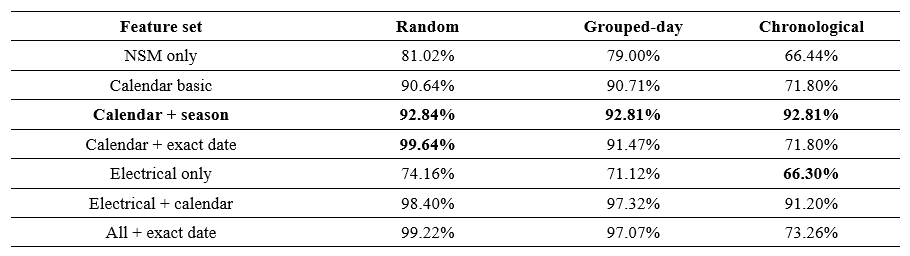
Introduction: The Steel Industry Energy Consumption dataset has been widely used for machine-learning classification of Load_Type. However, the provenance of this target and the effect of temporal structure on classification performance have received limited attention. This study evaluates whether high classification accuracy reflects physical industrial load recognition or reconstruction of predefined temporal rules. Method: The study analyzed 35,040 observations recorded at 15-minute intervals throughout 2018. Daily label sequences were audited and compared with the seasonal and time-of-day schedules documented in the original dataset source. A deterministic rule-based classifier was developed without machine learning. Random Forest was then evaluated using calendar-only, electrical-only, and combined feature sets under random-row, grouped-day, and chronological validation strategies. Results: Only three unique daily Load_Type patterns were identified across 365 days, with 303 days following two documented seasonal schedules. The deterministic baseline achieved 90.09% accuracy and correctly reconstructed all Medium and Maximum Load observations. Under chronological validation, calendar and seasonal variables achieved 92.81% accuracy, compared with 66.30% using electrical variables alone. Including exact calendar position produced 99.64% accuracy under random-row splitting but decreased to 71.80% under chronological evaluation. Conclusion: Load_Type contains a strong deterministic temporal component, and random-row validation can substantially overestimate temporal generalization. Classification performance should therefore be interpreted according to label provenance, predictor structure, and intended deployment conditions.
References
[1] V. E. Sathishkumar, C. Shin, and Y. Cho, “Efficient energy consumption prediction model for a data analytic-enabled industry building in a smart city,” Building Research & Information, vol. 49, no. 1, pp. 127–143, 2021, doi: https://doi.org/10.1080/09613218.2020.1809983.
[2] J. Walther and M. Weigold, “A systematic review on predicting and forecasting the electrical energy consumption in the manufacturing industry,” Energies, vol. 14, no. 4, Art. no. 968, 2021, doi: https://doi.org/10.3390/en14040968.
[3] F. Gu and Y. Zhao, “Comparative evaluation of several models for forecasting hourly electricity use in a steel plant,” Scientific Reports, vol. 16, Art. no. 13123, 2026, doi: https://doi.org/10.1038/s41598-026-43868-z.
[4] D. A. C. Narciso and F. G. Martins, “Application of machine learning tools for energy efficiency in industry: A review,” Energy Reports, vol. 6, pp. 1181–1199, 2020, doi: https://doi.org/10.1016/j.egyr.2020.04.035.
[5] V. J. Mawson and B. R. Hughes, “Deep learning techniques for energy forecasting and condition monitoring in the manufacturing sector,” Energy and Buildings, vol. 217, Art. no. 109966, 2020, doi: https://doi.org/10.1016/j.enbuild.2020.109966.
[6] Y. Hu and Y. Man, “Energy consumption and carbon emissions forecasting for industrial processes: Status, challenges and perspectives,” Renewable and Sustainable Energy Reviews, vol. 182, Art. no. 113405, 2023, doi: https://doi.org/10.1016/j.rser.2023.113405.
[7] S. Ma, Y. Zhang, J. Lv, Y. Ge, H. Yang, and L. Li, “Big data driven predictive production planning for energy-intensive manufacturing industries,” Energy, vol. 211, Art. no. 118320, 2020, doi: https://doi.org/10.1016/j.energy.2020.118320.
[8] V. E. Sathishkumar, C. Shin, and Y. Cho, “Steel Industry Energy Consumption,” UCI Machine Learning Repository, 2021, doi: https://doi.org/10.24432/C52G8C.
[9] J. J. Purnama and S. Rahayu, “Klasifikasi konsumsi energi industri baja menggunakan teknik data mining,” Jurnal Teknoinfo, vol. 16, no. 2, pp. 395–407, 2022, doi: https://doi.org/10.33365/jti.v16i2.1984.
[10] M. Chan, “Evaluasi efektivitas algoritma klasifikasi beban penggunaan listrik pada mesin pabrik baja,” Jurnal Komputer dan Informatika, vol. 20, no. 1, pp. 1–8, 2025.
[11] G. Tzionis, G. Kougka, I. Gialampoukidis, S. Vrochidis, I. Kompatsiaris, and M. Vlachopoulou, “Enhancing robustness in feature importance methods with NAFIC and CESHAP for improved interpretability,” Applied Artificial Intelligence, vol. 39, no. 1, Art. no. 2515062, 2025, doi: https://doi.org/10.1080/08839514.2025.2515062.
[12] M. Muthusamy, A. Sureshkumar, P. Shanmugam, P. R. Kaveri, M. Y. N. Mohamed, and S. Sridhar, “TinyML with CTGAN based smart industry power load usage prediction with original and synthetic data visualization towards Industry 5.0,” Scientific Reports, vol. 15, Art. no. 41712, 2025, doi: https://doi.org/10.1038/s41598-025-25678-x.
[13] G. Tzionis, G. Kougka, I. Gialampoukidis, S. Vrochidis, I. Kompatsiaris, and M. Vlachopoulou, “Improving LIME stability via density-awareness: Evaluation and comparison of AKDE-LIME,” Applied Artificial Intelligence, vol. 40, no. 1, Art. no. 2640686, 2026, doi: https://doi.org/10.1080/08839514.2026.2640686.
[14] A. Z. Jacobs and H. Wallach, “Measurement and fairness,” in Proceedings of the 2021 ACM Conference on Fairness, Accountability, and Transparency (FAccT ’21), 2021, pp. 375–385, doi: https://doi.org/10.1145/3442188.3445901.
[15] B. Hutchinson, N. Rostamzadeh, C. Greer, K. Heller, and V. Prabhakaran, “Evaluation gaps in machine learning practice,” in Proceedings of the 2022 ACM Conference on Fairness, Accountability, and Transparency (FAccT ’22), 2022, pp. 1859–1876, doi: https://doi.org/10.1145/3531146.3533233.
[16] S. Kapoor and A. Narayanan, “Leakage and the reproducibility crisis in machine-learning-based science,” Patterns, vol. 4, no. 9, Art. no. 100804, 2023, doi: https://doi.org/10.1016/j.patter.2023.100804.
[17] C. Bergmeir, R. J. Hyndman, and B. Koo, “A note on the validity of cross-validation for evaluating autoregressive time series prediction,” Computational Statistics & Data Analysis, vol. 120, pp. 70–83, 2018, doi: https://doi.org/10.1016/j.csda.2017.11.003.
[18] V. Cerqueira, L. Torgo, and I. Mozetič, “Evaluating time series forecasting models: An empirical study on performance estimation methods,” Machine Learning, vol. 109, pp. 1997–2028, 2020, doi: https://doi.org/10.1007/s10994-020-05910-7.
[19] D. R. Roberts et al., “Cross-validation strategies for data with temporal, spatial, hierarchical, or phylogenetic structure,” Ecography, vol. 40, no. 8, pp. 913–929, 2017, doi: https://doi.org/10.1111/ecog.02881.
[20] H. Hewamalage, K. Ackermann, and C. Bergmeir, “Forecast evaluation for data scientists: Common pitfalls and best practices,” Data Mining and Knowledge Discovery, vol. 37, no. 2, pp. 788–832, 2023, doi: https://doi.org/10.1007/s10618-022-00894-5.
[21] H. Azis, Nirmala, L. Syafie, Herman, F. Fattah, and T. Hasanuddin, “Unveiling algorithm classification excellence: Exploring Calendula and Coreopsis flower datasets with varied segmentation techniques,” in 2024 18th International Conference on Ubiquitous Information Management and Communication (IMCOM), 2024, pp. 1–7, doi: https://doi.org/10.1109/IMCOM60618.2024.10418246
[22] Purnawansyah, A. P. Wibawa, T. Widiyaningtyas, Haviluddin, H. Darwis, and H. Azis, “An in-depth exploration of supervised and semi-supervised learning on face recognition,” Open Computer Science, vol. 15, no. 1, Art. no. 20250029, 2025, doi: https://doi.org/10.1515/comp-2025-0029.
[23] A. Latip, H. Azis, H. Himawan, and D. A. Kurnia, “SMOTE technique utilization in cirrhosis classification: A comparison of Gradient Boosting and XGBoost,” International Journal of Informatics and Computing, vol. 1, no. 1, pp. 34–40, 2025.
[24] Harlinda, A. Rendi, H. Azis, D. Indra, L. N. Hayati, and N. Kurniati, “Classification of Cia-Cia letters using MobileNetV2 and CNN methods,” in 2025 19th International Conference on Ubiquitous Information Management and Communication (IMCOM), 2025, pp. 1–6, doi: https://doi.org/10.1109/IMCOM64595.2025.10857478.
[25] H. Azis, Y. Salim, and Y. Puspitasari, “Deep learning approaches for soft tissue classification of cephalometric images in orthodontics,” JOIV: International Journal on Informatics Visualization, vol. 10, no. 3, pp. 988–995, 2026, doi: https://doi.org/10.62527/joiv.10.3.3885.
[26] L. O. Lamidi, A. M. Oyelakin, and M. B. Akinbi, “A survey on machine learning techniques for the prediction of solar power production,” Indonesian Journal of Data and Science, vol. 5, no. 2, pp. 109–114, 2024, doi: https://doi.org/10.56705/ijodas.v5i2.130.
[27] R. K. Hondro, H. S. Ginting, P. J. N. Simanjuntak, H. T. Silalahi, and Sarwandi, “Use of machine learning in power consumption optimization of computing devices,” Indonesian Journal of Data and Science, vol. 6, no. 1, pp. 103–111, 2025, doi: https://doi.org/10.56705/ijodas.v6i1.231.
[28] E. H. Saputra, I. A. E. Zaeni, D. D. Prasetya, A. M. Zain, W. Antonius, and I. M. Wirawan, “Comparative evaluation of machine learning models for heavy crude oil viscosity prediction using repeated nested cross-validation and independent holdout testing,” Indonesian Journal of Data and Science, vol. 7, no. 2, 2026, doi: https://doi.org/10.56705/ijodas.v7i2.455.
[29] Ilham, “Enhancing cardiovascular disease prediction accuracy through an ensemble machine learning approach,” International Journal of Artificial Intelligence in Medical Issues, vol. 2, no. 2, pp. 95–103, 2024, doi: https://doi.org/10.56705/ijaimi.v2i2.157.
[30] N. El Furqany, “Optimizing air quality index classification using multiple machine learning models and oversampling techniques,” International Journal of Artificial Intelligence in Medical Issues, vol. 3, no. 2, pp. 127–141, 2025, doi: https://doi.org/10.56705/ijaimi.v3i2.322.
Downloads
Published
Issue
Section
License
Copyright (c) 2026 Nusantara Journal of Multidisciplinary Informatics
Creative Commons Attribution-NonCommercial 4.0 International (CC BY-NC 4.0)Copyright remains with the author(s), and articles are published under Creative Commons Attribution-NonCommercial 4.0 International (CC BY-NC 4.0).